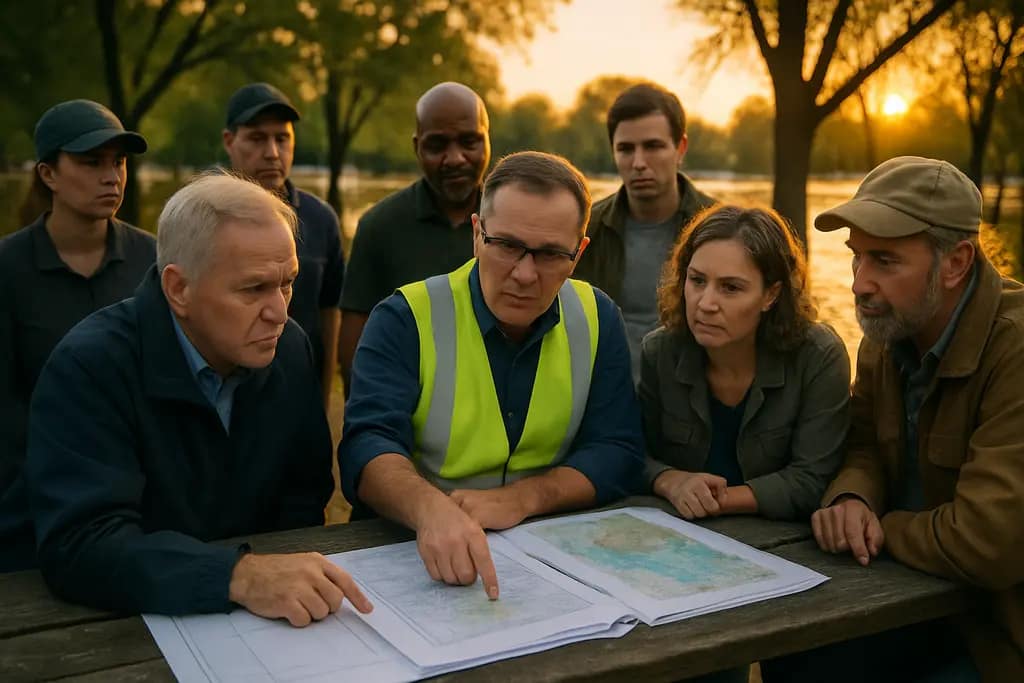
Arvada Flood Improvements moved forward on September 15, 2026, when the Arvada City Council approved an intergovernmental agreement with the Mile High Flood District for design and construction of drainage and flood control work at the Arvada Center, according to the city’s Sept. 15 council recap. For park users, trail users, nearby residents and businesses that depend on reliable access, the vote marked a civic step from planning toward funded public works. The council also approved a $9.6 million construction contract with Arrow-J Landscape and Design for the Gold Strike Park redevelopment project, an action city records tied to the same meeting.
What Arvada Flood Improvements Approved On September 15 Means
Council Action And Agency Partnership
The September 15 approval matters because flood control work often requires more than one public agency. In this case, Arvada acted through an intergovernmental agreement with the Mile High Flood District, the regional agency that helps fund drainage and flood control projects across the Denver metro area. The city’s action did not name a private property outcome, a business-by-business protection level, or a specific public closure schedule in the council recap. What it did establish was a formal path for design and construction funding at the Arvada Center drainage area.
The Mile High Flood District’s Five-Year Capital Improvement Plan for 2024-2028 listed “Hidden Lake Drainageway at the Arvada Center” with a $200,000 budget spread across 2026 and 2027, including $100,000 in 2026 and $100,000 in 2027, according to the MHFD capital plan. That budget listing gives residents a clearer sense of timing than a general project mention would. It also shows that the work is part of a multi-year program rather than a one-day repair.
Funding Signals For Residents
For residents who use the Arvada Center area, the immediate effect is not a completed drainage project. As of October 2, 2026, the key change is the approval of the agreement and the assignment of planned funding. That distinction matters for civic tracking: people can now watch for design milestones, construction schedules, public notices, and any temporary access changes that may follow.
Arvada Flood Improvements also sit beside a larger public investment at Gold Strike Park. The $9.6 million contract approved on September 15 was for redevelopment at a park located at the confluence of Clear Creek and Ralston Creek. Research from city materials identifies that park as listed on the State Register of Historic Places and describes planned work that includes walkways, ecosystem restoration, trail connections, interpretive art, and recreation features. The research also states construction was expected to begin in fall 2026 and reach completion by fall 2028. The council recap confirms the contract award, while the timing and feature details should be checked against future city notices as work proceeds.
Park Access And Creek Corridor Changes
How Arvada Flood Improvements Affect Park Users
For regular park users, Arvada Flood Improvements are likely to be felt most through access, safety and construction staging rather than through a visible change on the day after approval. Drainage projects can affect where people walk, bike, park, and cross near creeks, especially during design and construction. The research notes that Gold Strike Park redevelopment is tied to walkways, trail connections, restored meadows, bridges, picnic pavilions, playgrounds, creekside education features, and safer creek crossings. Those are public-facing changes, but the city’s approved council recap does not provide a day-by-day construction access plan.
Residents should be careful not to assume all park areas will be open or closed at the same time. Large park projects often move in phases, and creek corridor work can shift based on weather, water levels, permitting, and contractor schedules. The supported civic takeaway is narrower: Arvada has approved funding agreements and contracts that point toward construction activity affecting park spaces and creek connections from fall 2026 into fall 2028 for Gold Strike Park, while the Arvada Center drainage project is budgeted across 2026 and 2027.
Lessons From Ralston Creek Work
The research also points to the Ralston Creek Improvement project near the West Woods subdivision, where trail realignments and safer crossings were completed and the trail near West Woods reopened in late August 2025. That prior project is useful context because it shows the type of public benefit flood-mitigation work can bring: improved sight lines, a soft surface trail, and landscaping planned for longer-term function. It does not prove that the Arvada Center or Gold Strike Park projects will follow the same construction pattern, but it gives residents a local example of creek work tied to trail access.
For walkers, cyclists, families, and recreation groups, the best next civic step is to monitor city meeting recaps, public works updates, and posted park notices. If temporary detours are announced, users should expect those notices to carry more practical weight than early project descriptions. Park access questions are also useful public comment topics because they ask staff to explain how trail users, people with mobility needs, and families using picnic or play areas will be accommodated during construction.
Downtown Business Access And Public Comment

Olde Town Access Concerns
For downtown businesses, the direct impact is less certain than the public works action itself. The research states that Olde Town paid parking came up during public comment at the same September 15 council meeting. That fact is relevant because parking, sidewalk access, delivery routes, and customer circulation are core daily concerns for storefronts. Flood control work near major creeks and drainage paths may reduce future disruption risk, but the city recap did not quantify any expected reduction in business losses, name protected storefronts, or promise uninterrupted access.
That means Arvada business owners have a practical reason to stay engaged, especially if they depend on predictable traffic between Olde Town, nearby arterial roads, trail corridors, and event destinations. Public works projects can improve long-term reliability while also creating short-term construction questions. A business may need to know whether a delivery route changes, whether a parking lot entrance is affected, or whether pedestrian access will be maintained during certain phases. Those details were not included in the research provided, so they should be verified through future city notices before owners make operating decisions.
What Businesses Can Track
Arvada Flood Improvements should be tracked alongside other local access issues, not treated as a stand-alone engineering topic. For storefronts, the key questions are simple: whether flood and drainage work will protect approaches to commercial areas, whether construction will affect customer routes, and how far in advance the city will post notices about any detours. Chambers and business groups often help translate public works schedules into plain information for merchants. Those interested can find further insight through the Richland Chamber, a related site offering resources for the business community.
The research suggests that improvements near drainage paths are intended to reduce flood liability along major creeks, improve conveyance during high-rainfall events, improve safety for nearby parks and trails, and reduce potential infrastructure damage. Those goals matter for businesses because flood disruptions can cut off parking areas, sidewalks, loading zones, and customer access. Still, it would be too strong to say the September 15 vote alone eliminates those risks. The better reading is that Arvada and the Mile High Flood District have advanced a funded step in a longer risk-reduction program.
Arvada Center And Gold Strike Park Next Steps
Public Questions Worth Asking
As of October 2, 2026, the next community task is oversight. Residents can ask when the Arvada Center drainage design will be presented, whether public meetings will be scheduled before construction, and how city staff will communicate any effects on parking, trails or entrances. For Gold Strike Park, residents can ask how the $9.6 million construction contract will be phased between fall 2026 and fall 2028, and whether the city will publish maps showing which areas remain open.
People who use the parks daily may have different needs than occasional visitors. A parent may care most about playground timing. A cyclist may need detour maps. A nearby resident may focus on creek crossings and stormwater behavior. A business owner may need lead time for parking or delivery changes. Those are all valid civic questions because the same public works decision can affect the community in different ways.
The practical value of Arvada Flood Improvements will depend on design quality, construction coordination, public notice, and follow-through by city and regional flood officials. The September 15 approvals did not finish the work. They did, however, create a documented public step for drainage, flood control, park redevelopment and future access planning in parts of Arvada where parks, creeks, civic facilities and commercial activity meet.
Leave a Reply